



Born in Japan, Koharu Itagaki moved to Germany with her family just before starting elementary school. She is now studying at a selective secondary school in Bavaria (Gymnasium) while also turning in remarkable results as a Germany national team player, including winning the girls' Singles title at the 2025 World Youth Championships (U15). The 16-year-old, who values her own pace rather than being bound by an overly packed training schedule, has climbed to the top of the world. We took a closer look at her journey and her true self.
(Interview: Yuki Ogawa / Tournament photos: WTT / Cooperation: Tamas Co., Ltd., the Itagaki family)
Featured in O-KOKU December 2026 issue
She started table tennis “to kill time,” then built her own style around the Hiraoka theory
―― You moved to Germany when you were little, but do you remember anything from the time you were in Japan?
Koharu Itagaki (hereafter Koharu) I only vaguely remember the outside of the house where we lived in Aomori, and the table tennis hall at Aomori Yamada Gakuen where my father (Koji) coached.
―― You started table tennis after moving to Germany. What was the training environment like back then, and what got you started in the first place?
Koharu The first time I played was in the gym of the club in Bad Königshofen, where my father was the coach. It was a very small space, with only two tables. Next to us, three big older boys, around 180 cm tall, were practicing, and beside them my twin brother Harune and I, and sometimes my older brother Kion, who is five years older, would join in, and the three of us would just kind of rally back and forth.

The Itagaki family sightseeing in Prague after a training camp in the Czech Republic in 2018. From left: Harune, Koji, Kion, Koharu, Shinobu (mother)
―― So you didn't start because you said, “I want to play table tennis”?
Koharu Not at all haha. I was taken along to my father's training sessions, and since I had nothing to do, just sitting and waiting was boring and tiring... that's why.
At first, I really hated training. For example, if they said, “Practice until 6:30,” I would be the first one to stop the moment it hit 6:30. When I was in elementary school, I think I practiced about one hour a day.
―― Your table tennis style is distinctive, using short pips on the backhand for variation and smashing with the forehand. Was the backhand rubber short pips from the start?
Koharu When I first started table tennis, I used inverted rubber on both sides, but when I was around 7 or 8, I saw a player using short pips and thought, “That looks interesting,” so I asked to switch. There aren't any kids around me who play in the same style, so I think it's a kind of table tennis that's hard to copy.
―― Who coached you?
Koharu I've been coached by Yoshihiro Hiraoka from Japan (FLAT HILL) since I first started playing, and “Hiraoka theory” is the foundation of my game. Mr. Hiraoka comes to Germany about once a year to hold a camp, and whenever I go to Japan during school breaks, he always coaches me.
She got serious after competing internationally, and went on to become the U15 world youth queen
―― When did the training-hating Koharu start taking table tennis seriously?
Koharu It was when I was 12 or 13. I won a domestic junior (U15) tournament and then started competing in international events, and that was the trigger. I started wanting to win more, and from then on I put real effort into training until I felt satisfied with it.
In 2023, I won the team event at the European Youth Championships U15 for the first time, and also took the doubles title. In 2024, I finished third in singles at both the European Youth Championships and the World Youth Championships. Then in 2025, I won the singles title at the European Youth Championships... .
―― And then you won the World Youth singles title in brilliant fashion. Could you walk us through the battles you had during the event?
Koharu In the Quarter-final, I had a tough time because Vizhitviriyakul from Thailand was so powerful on both wings, but I won 4-2. In the Semi-final, I played Muramatsu Kokona from Japan for the first time, and it turned into a back-and-forth variation battle that went all the way to the deciding game, but I kept fighting and somehow won 4-3.
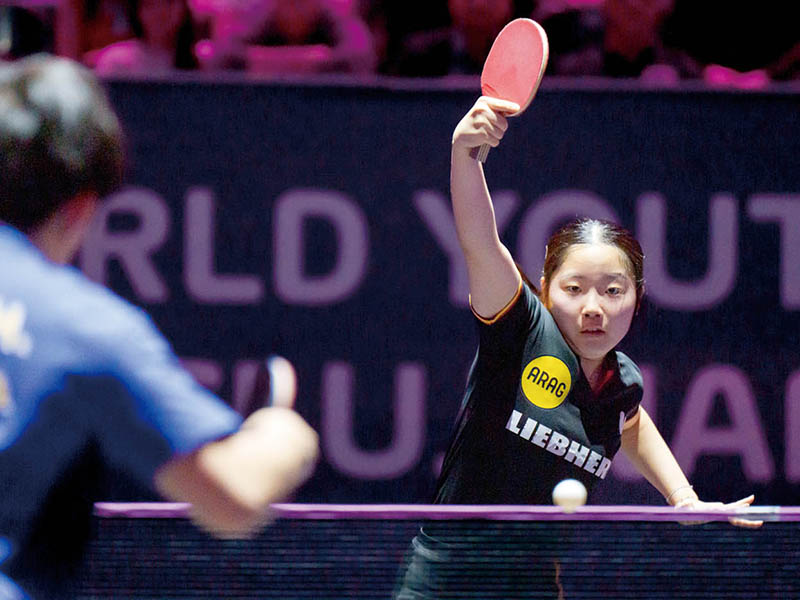
Girls' Singles Final at the 2025 World Youth Championships U15. Itagaki Koharu defeated the formidable Zhu Qihui of China to capture the title in style
―― Your opponent in the Final was Zhu Qihui of China.
Koharu I had lost 0-3 to her at a tournament in France in April that year, so I had no image at all of being able to beat her, and went in with a challenger’s mindset. But in the deciding game I got to 10-6, and the moment the barrier around the court lit up with “CHAMPIONSHIP POINT,” I suddenly got really nervous.
Then I lost a point and it became 10-7, and at that moment camera flashes went off in the stands. Thanks to that, I was able to let out a breath, calm myself, and take a deep breath, and I managed to score the final point. The moment I won, everything around me lit up, and it felt like an unbelievable dream.
She studies hard, takes time to unwind, and keeps aiming for the dream of Olympic gold
―― When you moved to Germany at age 6, I’m sure there was also a language barrier. How did you overcome it?
Koharu I went to kindergarten for three months before entering elementary school. At first I didn't understand anything, but as I talked with the friends around me, I naturally picked up German.
―― The school system in Germany is very different from Japan’s. What does your daily schedule look like?
Koharu When I was in elementary school, school finished in the morning, around 11:15, and I would go home and eat lunch there. Now I've just started 11th grade at Gymnasium, a 13-year preparatory school, and there too, school basically finishes around noon. On the other hand, classes start at 7:30, so mornings are early.
―― Many Japanese players spend long hours immersed in table tennis, but is your life in Germany quite different?
Koharu The kids in Japan practice a lot every day, so I imagine they get tired from table tennis, but for me the bigger stress is school tests, oral questioning, and surprise tests.
When I miss school for an overseas trip, I have fewer chances to take tests, so each grade carries more weight. There is also the risk of failing, so I can’t let my guard down. The teachers at school are there to teach academics, and they barely understand my table tennis, so that part is pretty strict.
―― How do you spend your free time outside of studying and table tennis?
Koharu I often make sweets and hang out with friends. And I also listen to music and play games... that kind of thing.
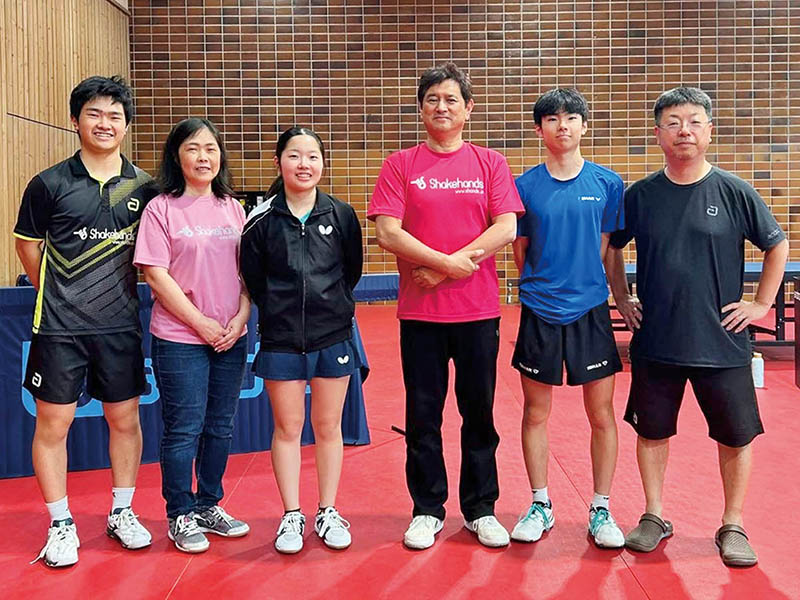
At the Bad Königshofen training hall in 2026. From left: Kion, Shinobu, Koharu, Coach Hiraoka, Harune, Koji
―― Please tell us about your current training environment and activities.
Koharu I basically train at my local club in Hilpoltstein, and when there are Bundesliga matches, I compete for the Dachau team. My teammate includes Winter from the Germany national team, and we sometimes train together, such as during warm-ups before matches.
―― What are your goals going forward?
Koharu In the near term, my goal is to compete at the Youth Olympic Games and the World Youth Championships and give everything I have there. My big dream for the future is to win an Olympic gold medal.
But I want to keep aiming higher while enjoying myself at my own pace, without being pushed too hard.
―― We hope you’ll keep balancing your studies and table tennis, and become a good rival for Japanese players. Thank you very much for your time today.
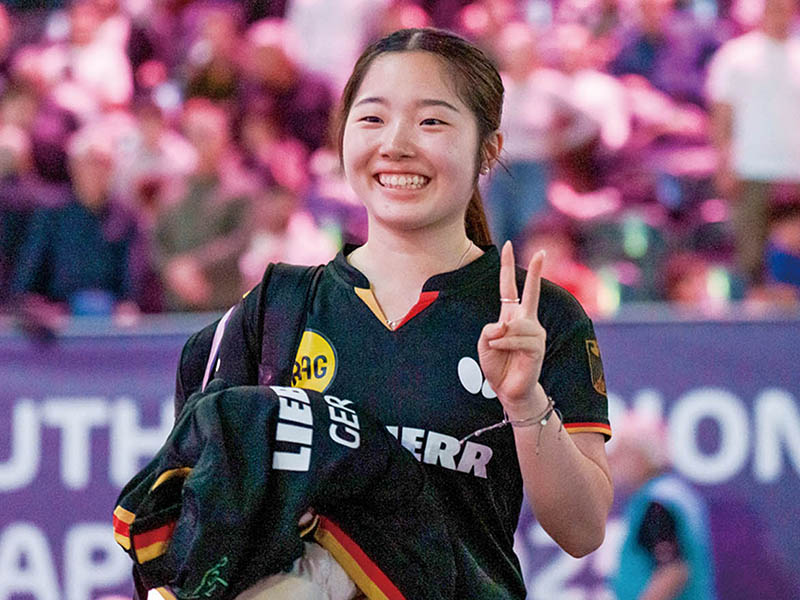
Koharu Itagaki
Born January 27, 2010, from Iwate Prefecture. At age 6, when her father Koji (now head coach of the MTTL Atlanta Blazers in the U.S.) took up a coaching job in the Bundesliga, the family moved to Germany. She soon began playing table tennis. She acquired German citizenship in 2023, and as a representative of the country, she finished third in the U15 singles at both the European Youth Championships and the World Youth Championships in 2024, then won both in 2025. In the Bundesliga, she belongs to Dachau, the same club as Germany national team player Winter
Share


