



Published in the December 2026 issue of O-KOKU / The fate of table tennis players: “Talking Everything About Net Balls and Edge Balls!”
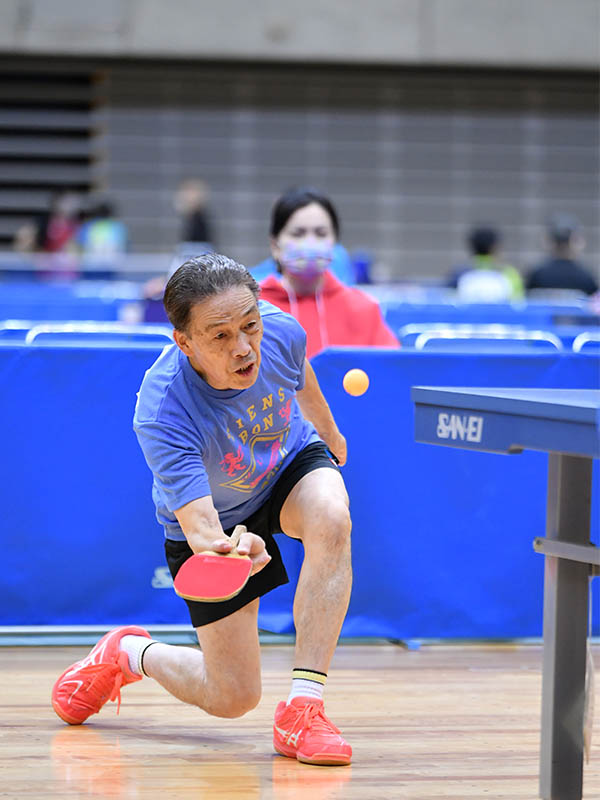
Vol. 5 Chikara Murakami 〈Kikyō Kurabu〉
Chikara Murakami
Born June 14, 1949, from Iwate Prefecture. Winner of the mixed doubles at the 1980 All Japan Championships, two-time winner of the Masters Division “Thirty” at the All Japan Championships, and a multiple-time winner of the All Japan Large Ball Championships and the National Large Ball Tournament
You must not let your mental state be shaken. It’s nothing more than a “trick of the Table Tennis God.”
With a higher Net and a larger Ball, and playing with short pips, Large Ball sees many Net balls.
“The master of Large,” Chikara Murakami, talks about Net balls and Edge balls in Large.
In Large Ball, the Net is higher than in regular hardbat table tennis, and the Ball is larger, so Net balls happen often. What’s more, because a Ball that clips the Net doesn’t bounce back well, it’s difficult to make a Return.
Also, when a Net ball or Edge ball occurs, it has a two-point effect on the Match. For example, if your Opponent’s Ball clips the Edge at 5–5, then without that you might have taken a 6–5 lead, but instead it becomes 5–6. In an 11-point game, a two-point gap has a major impact on the outcome.
However, in Large Ball, a Ball coming in off the Net should not be seen as “bad luck,” but as something “normal.”
And even when a Net ball is difficult to Return, if you can see a 2- to 3-cm gap between the Ball and the table before the second bounce, slide your Racket in instantly and somehow get it back. That is the skill of a top-level Player.
At that moment, simply watching the Ball with your eyes won’t be enough. The instant the Opponent’s Ball hits the top of the Net, you must reflexively move forward. It is extremely important to make this a habit from the practice stage.
Then, while moving forward, relax your grip on the Racket, and if you judge that you won’t make it, regrip the end of the handle. That’s because it extends your reach by 2 to 3 cm. With that tiny difference, you can reach the Ball and make the Return possible. If you keep this awareness in your practice every day, it can save you from absolute despair in a Match.
In the case of an Edge ball, get your Racket out before the Ball hits the Floor, and curve the Ball even more before returning it. That’s also one of my specialties. Anyone who gives up on a Net ball or Edge ball right away is a third-rate Player.
Whether I lose in the first round or anywhere else, once I’m on the court, it’s life or death. That’s why I chase every Ball as if it were life or death.
I don’t have much power in my Ball, nor much Speed or strength. I’m not tall, and my arms and legs are short. I’m slow at running, too. If that’s the case, then all I have left is guts. I have no choice but to chase the Ball with guts. Whether you can pick up Net balls or Edge balls is, in the end, a matter of spirit.
On the other hand, when a Ball I hit becomes a Net ball or Edge ball, I may apologize to my Opponent, but I have never once shouted, “Yes!” I believe that in table tennis there is sportsmanship and manners, so you should not celebrate.
Even if your Opponent’s Ball becomes a Net ball or Edge ball during a Match, you must not let your mental state be shaken. It’s nothing more than a “trick of the Table Tennis God,” and your Opponent did not intentionally aim for it. If you grumble about or get discouraged by such unavoidable Balls, you won’t be able to seize Victory. The important thing is to accept it and say, “The gods played a trick on me.”
Share


