



Featured in the December 2026 issue of O-KOKU / The fate of table tennis players: “Talking at length about Net In and Edge Balls!”
Let’s hear in full from top players and coaches about the Ball that everyone experiences in a Match—sometimes lucky, sometimes unlucky—when it touches the Net and drops onto the court, known as a “Net in,” and the Ball that hits the corner of the Table and goes in, known as an “Edge ball.”
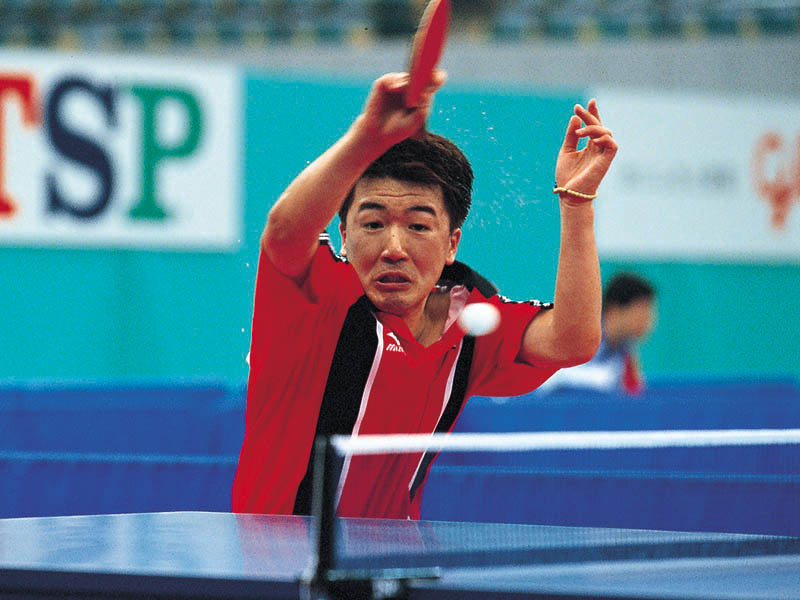
vol. 5 Toshio Tasaki
Toshio Tasaki
Born November 1, 1974, from Tochigi Prefecture. Competed in three Olympic Games and reached the men’s Singles round of 16 at the 2000 Sydney Olympics. Finished third in the team event at the 2000 World Championships and won the men’s Doubles at the All Japan Championships four times
At my first World Championships, I learned how to handle it from Norio Takashima
With his powerful two-wing Fast attack using short pips on the forehand, Toshio Tasaki was feared by overseas powerhouses as “Kamikaze.” He learned from coaches and senior players, and developed the self-control to handle Net ins and Edge balls.
I was a pen-hold short pips Fast attack player, and because of the nature of the Rubber, which makes the Ball travel more straight, I may have had a lot of Net ins, but I don’t really feel that I had an especially high number of Net ins in Match play.
In table tennis, from the beginner stage, where you rally by hitting high Balls back and forth, as the level rises, you start exchanging lower and more demanding Balls. In that sense, you could say that the better the Player, the more Net ins there may be.
In a Match, Net ins and Edge balls can keep going your way, or they can keep going your Opponent’s way. I think that happens because of how your game styles match up, but after all, the Players who score with Net ins and Edge balls are the ones who keep playing to the end without giving up. They fight desperately for Balls that seem impossible to reach, and that’s how a lucky Point comes. That’s where they bring in “luck.”
I hear that baseball Player Shohei Ohtani is the kind of person who picks up even the smallest piece of trash if he sees it on the ground in everyday life, steadily “collecting luck,” and I’d like to think I’m the same type. People may say that sounds old-fashioned, but it shows how much effort you’ve put in, how much you’ve devoted yourself to table tennis. What you’ve built up in daily practice is what may lead to a lucky Ball in a Match.
Also, when I first appeared at the 1993 World Championships in Gothenburg while I was in university, I learned from Norio Takashima, who was then the coach of the Japanese men’s team, how to maintain self-control when Net ins and Edge balls happened.
Those lucky Points happen to you, and they happen to your Opponent too. The conditions are the same, so you must not let your mind be shaken—that was Takashima’s lesson.
When I was active, I also played in Germany, and in Europe there are Players who let their emotions explode with a loud shout when the Opponent gets a lucky Point. But they make it look as if they’ve lost emotional control, then quickly switch gears. On the other hand, when young Japanese Players imitate that, there are cases where they can’t recover in the end and lose. I suppose it’s a matter of national character. When I was young, I also sometimes got irritated by my Opponent’s Net ins and Edge balls and lost my composure. After joining the national team, Takashima and the senior players taught me, “Just hold back, and after the Match, shake hands properly and come back.” Little by little, I was able to grow mentally.
Takashima also taught me, “After you get a lucky Point yourself, you must attack.” It was basically a Point you were given, as if the mistake had already been made for you, so he told me, “Don’t relax there; next, go and win the Point yourself.”
And when they get a lucky Point, top Players properly raise a hand or lift an index finger to apologize to the Opponent. Not getting carried away there may be a kind of mental control too, but at the same time, I think it also shows the greatness of table tennis as a sport that cares about the Opponent.
Share


