



Published in O-KOKU December 2026 issue / Knuckle special feature “Let’s win with knuckle balls!” ①
Top players & coaches on “This is how I use knuckle balls!”
Junko Haga
[Haga Table Tennis Club / right-handed shakehand, forehand inverted rubber, backhand short pips / Chop-style]
■Profile Junko Hagyoshi
Born June 30, 1967, from China. As a Chinese national team Player, she finished third twice in the women's doubles at the World Championships. After coming to Japan, she played for Nissan Motor and Sanritsu, among others, and naturalized in 2000. She contributed to Japan’s third-place finish in the team event at the 2001 World Championships, where she competed for the Japanese national team. After retiring, she has coached elementary and junior high school students at Haga Table Tennis Club in Tokyo.
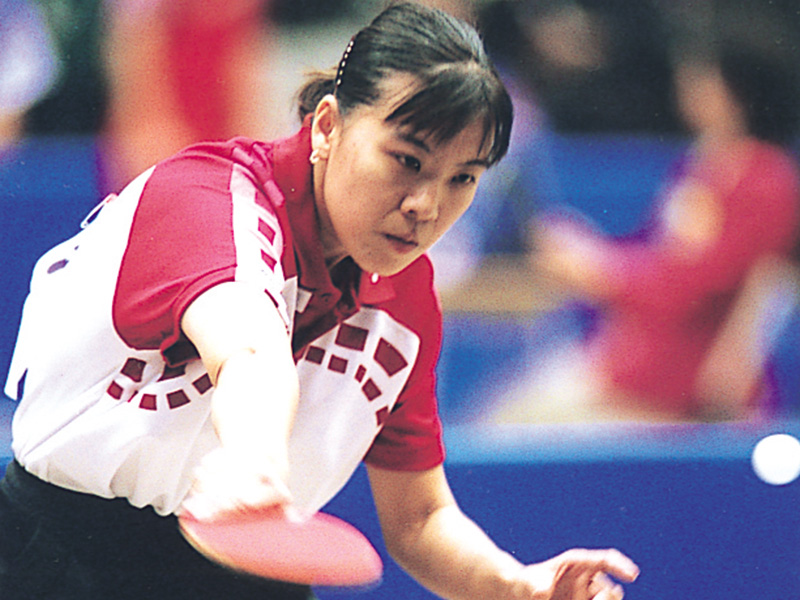
Junko Haga, who excelled on the world stage for both China and Japan, says that for a Chop-style Player, the purpose of using knuckle balls is to create “Attack” opportunities.
After making the opponent aware of backspin with chopped chops and pushes, send in the knuckle ball
For a Chop-style Player, whether on a Push or a Chop, learning to distinguish between spin (backspin) and no spin (knuckle) is a must.
As a basic stroke, whether chopping or pushing, you contact the ball on the lower side of the racket when applying spin, and on the upper side when not applying spin. A chop without spin uses a smaller backswing than a spinning chop, with the racket face slightly more open, and the swing feels a little more like pushing through the Ball. It is also important to make contact from a position lower than the table so the opponent cannot read the variation.
Using both spinning and non-spinning chops to force errors through changes in spin is fundamental for a Chop-style Player. On top of that, I was taught in China to “link the change between spin and no spin to attack.”
First, when the opponent drives or smashes a chopped Ball and misses the net, they will often start trying to keep the rally going with Pushes or loop drives. Not only that, but if they Push against a chopped Ball, the backspin remains strong and the return tends to come back low and sharply, making it difficult to attack.
However, if you send a knuckle chop to an opponent who is expecting a spinning chop, there is a chance they will return it with a floated Push or a high drive. That is the Ball you want to target and attack. A Push against a knuckle ball has little spin and tends to become a soft Ball, which also makes it easier to attack.
First, use spinning chops and Pushes to make the opponent miss and get them thinking, “I need to brush it up with spin” or “It’s spinning, so I should just keep it in play.” Once you’ve made them conscious of backspin, send in the knuckle ball to create a chance, or wait for them to keep it in play and then attack. I was very good at this pattern of attacking off backspin and then knuckle ball.
Even if you create a chance with a knuckle ball, there is no point if you just keep the rally going with Pushes or chops
From that perspective, if you use knuckle balls, even as a Chop-style Player, it is important to improve your attacking skills. Even if you create a chance with a knuckle ball, there is not much point if you simply continue the rally with Pushes or chops.
If you only use spinning Balls, the opponent will keep blocking and countering; if you only use knuckle Balls, they will start hitting them away freely. It is precisely because there is a spinning Ball that the knuckle ball becomes effective, and because the knuckle ball is effective that you can attack. What matters is thinking through what you will do after sending the knuckle ball.
Also, the reason many Chinese Chop-style Players, myself included, use short pips rather than long pips is that they value the variation between backspin and knuckle balls.
With long pips, spin and variation are heavily affected by the opponent’s Ball, and the range of variation you can create is limited. Short pips, on the other hand, let you Control the type and amount of spin yourself, making it harder for the opponent to read the variation.
A Chop-style Player certainly needs the ability to keep the rally going, but if you learn the variation between spin and no spin, I believe your tactical options will expand greatly.
Share


