



The True Story of Table Tennis <2> Published in the July 2020 issue of O-KOKU
Jota Ito (ITO Jota), the author of the table tennis history manga "Manga de Yomu Table Tennis Monogatari" (published by O-KOKU) and a table tennis columnist, introduces the fascinating stories hidden in the history of table tennis and the background behind them. He explains the truth behind the birth of table tennis, as painstakingly uncovered by a table tennis history fanatic. (Part 2)
*This article reprints the content as it appeared in 2020. The information is from that time.
● References: Sports Studies Series, "Tennis and Dress," edited and written by Masahiro Inagaki (Soubunsha); "Table Tennis Collector" ITTF
[The Birth of Table Tennis]
<Continuation from Part 1>
Lawn tennis, which began with “jeu de paume” and blossomed in mixed Dobles
In a French monastery in the late 11th century, a game called “jeu de paume” was born. In English, jeu de paume would mean game of palm, or in other words, the “palm game.” It was a game in which a Ball stuffed with hair or cloth inside a leather pouch was struck with the palm of the hand.
By the middle of the 16th century, Rackets strung with gut were being used, and before long the game came to be called “tennis.” The most widely accepted theory is that “tennis” comes from the French “tenez” (“Here you are”), but there are several other theories as well, and nothing has been definitively established. By the 18th century, it had spread across Europe, but tennis at that time was quite different from modern tennis. It was played in a dedicated building called a “ball game hall,” and was more or less a combination of modern squash and tennis, making use of rebounds off walls on all sides. It was a sport for the upper classes, such as nobles, and for them alone.
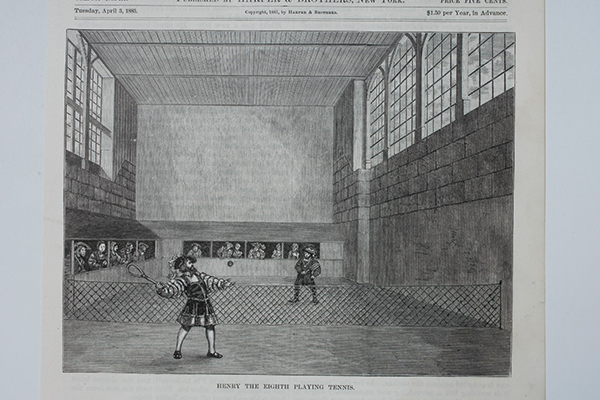
Henry VIII enjoying “jeu de paume” in the 16th century (painted in 1883)
In the 19th century, members of the middle class—businesspeople and intellectual professionals—who had rapidly grown wealthy thanks to the Industrial Revolution began to seek entertainment. In that context, in 1873 a man named Walter Clopton Wingfield released a set consisting of a net that could be set up outdoors and a rubber Ball that would bounce on grass, marketed as “lawn tennis.” In other words, if you had a lawn, you could play something like tennis anywhere. It became a huge craze almost overnight.
The key to that boom, surprisingly enough, was mixed Dobles. At the time, opportunities for unmarried men and women to meet were limited. There were group amusements such as dancing and croquet (the sport that became the basis for gateball), but nothing that let men and women pair up one-on-one for fun. So Wingfield sold this game as something to be played in mixed Dobles. People flocked to it. History often moves on the basis of just that sort of principle.
The craze was so enormous that tennis parties were held almost every week in the homes of people with large gardens. Since these were family parties, the girls served tea and cake, while the boys took on the role of picking up Balls that rolled into plants and shrubs. That was the beginning of the ball boy. Today, table tennis also has ball boys and ball girls, but originally that was a custom unique to tennis. The strange practice of having children pick up Balls at adult international tournaments actually originated in home tennis parties, if you think about it.
As early as 1877, the first Wimbledon tournament was held. A certain tennis club, as a stopgap measure to raise money to repair the roller used to maintain the courts, came up with the idea of offering prize money, gathering players, and charging spectators admission. Since this turned out to be more profitable than expected, tennis tournaments would go on to develop greatly as commercial events. In contrast to table tennis, tennis tournaments were commercial events from the very beginning.
Lawn tennis came to Japan as early as the year after the Wimbledon tournament. It was educational scholar Kanaan Chuman who named it “teikyū” (garden tennis), but it is not certain whether he did so after learning about tennis parties in British homes, or whether he simply made the association from lawn grass.
Share


