



A True Story of Table Tennis, Part 3, published in the August 2020 issue of O-KOKU
Jota Ito, the original author of the table tennis history manga "Manga de Yomu Table Tennis Monogatari" (published by O-KOKU) and a table tennis columnist, introduces amusing stories hidden behind the history of table tennis that could not be fully covered in the manga. In this third installment, we look at the first half of "The Invention of Ping-Pong." So, what behind-the-scenes stories are hiding here...?
*This article is a reprint of the content as it appeared in 2020. The information is from that time.
●References: "TABLE TENNIS COLLECTOR" ITTF, "PING PONG FEVER" Steve Grant
[The Invention of Ping-Pong]
The Invention of Ping-Pong, the Start of an Epic Table Tennis Story
One day in 1900, James Gibb, who ran a metalworking company in London, found a toy celluloid ball while on a business trip in New York. Gibb, who was also a fine long-distance runner, loved sports. It is said that he used a champagne cork shaved into a round shape as a ball and the lid of a cigarette case as a racket to imitate tennis at the dining table. Another account says he bought and enjoyed the table tennis set "GOSSIMA" released by Jakes and Son.
Gibb came up with the idea of using the celluloid ball for that game. This idea would go on to change the history of table tennis.
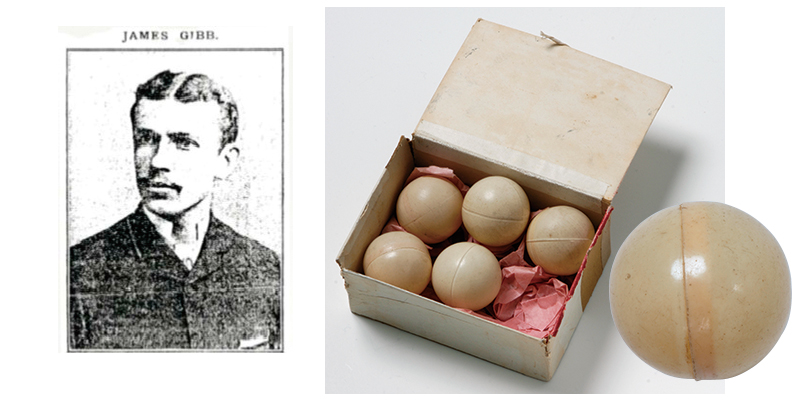
James Gibb, the greatest benefactor in table tennis history (left photo); right photo: the celluloid ball of the time
After returning to London, Gibb immediately introduced this new ball to his acquaintance John Jakes III, who had taken over Jakes and Son. Compared with the ball used in "GOSSIMA," which had a rubber surface covered with netting, the celluloid ball bounced much more briskly. And, conveniently, at just 2 grams, it was extremely light, so there was no worry about breaking dishes or other items even when playing indoors. Nothing was better suited to a game played in the living room.
Jakes and Son quickly replaced the ball in "GOSSIMA," which had gone on sale nine years earlier but had sold virtually nothing, with the celluloid ball, added Ping-Pong to the product name, and released it as "GOSSIMA or PING PONG." This was in September 1900.
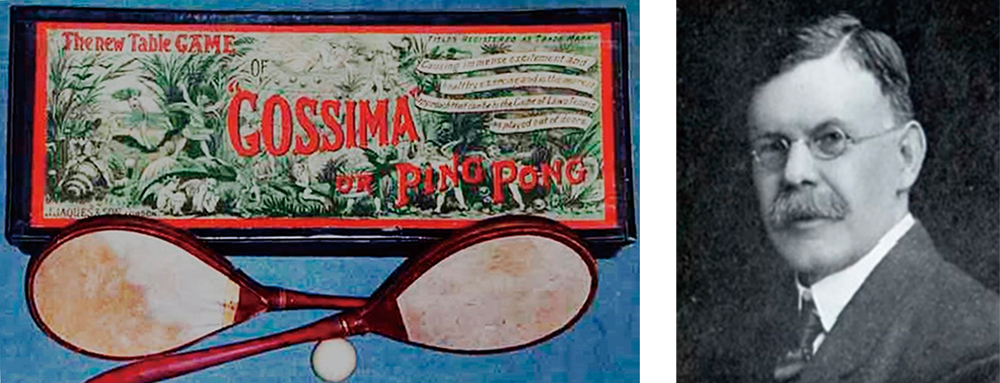
"GOSSIMA or PING PONG," which sparked a feverish table tennis boom (left photo); right photo: John Jakes III of Jakes and Son, the company that launched "GOSSIMA or PING PONG"
Share


