



From O-KOKU Books, "The Door to Table Tennis Heaven" 〈28〉
The sequel to table tennis columnist Jota Ito’s uproarious table tennis column collection, "Welcome to Table Tennis Hell," is "The Door to Table Tennis Heaven" (published in 2015). With this one book, you will open the "door to heaven." ☆A concentrated extract of table tennis mania☆
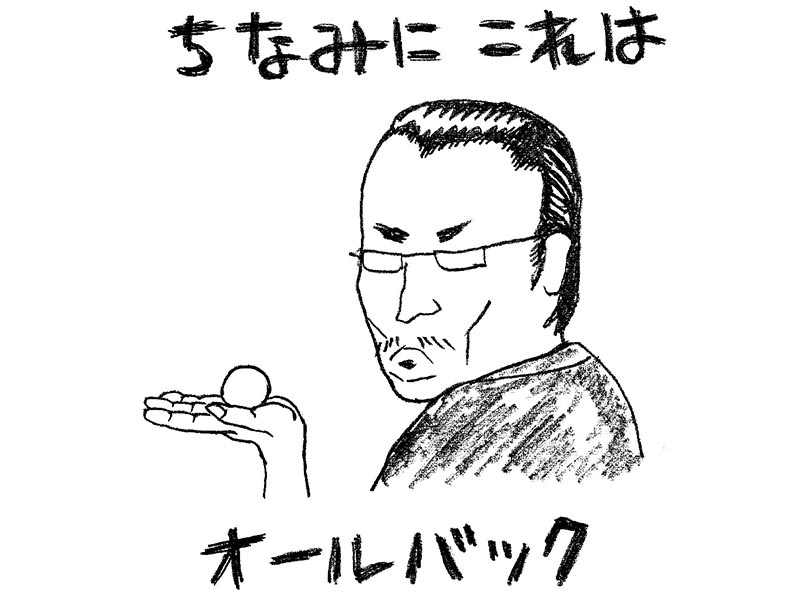
Text & Illustration by Jota Ito
Chapter 3: Doubt the Common Sense of Table Tennis!
The Labyrinth of All Forehand
Since Japan lost to China in the 1960s, people have kept saying that Japanese offensive players are too biased toward the forehand. It is only in the last few years that this has finally stopped being said. In their coauthored book, Sweden’s table tennis journalist Jens Fellikka and former national team coach Glenn Öst wrote of Japan’s all-forehand table tennis in "The Secrets of Sweden’s Strongest Table Tennis" (Yamato Table Tennis, 1991 / out of print): "It is a sign that the flow of the game and the opponent’s ability are being underestimated." That is a rather stiff way of putting it, but in casual terms, it means, "You guys are looking down on table tennis, aren’t you?" Japan’s fixation on all forehand was that abnormal. What on earth caused it?
The first reason lies in the Japanese reverence for devotion to a single path. As reflected in proverbs such as "slow and steady wins the race" and "if you chase two rabbits, you catch none," Japanese people tend to value devoting themselves to one thing. Even when I started table tennis in the late 1970s, people would say things like, "It’s arrogant to swing your backhand before you can even play forehand," or "Don’t attack if you’re a chop player," and I accepted that too. In short, whether it is forehand or chop, we are a people who feel good about mastering just one thing.
Looking further back in the history of Japanese table tennis, something even more interesting comes to light. Table tennis was introduced to Japan in 1902, and it is said that short play was the first style to become established as a competitive stroke. In the late Taisho period, long play emerged to break through it, and around 1935 chop then came into its own in response. After that, all-round play, combining these styles, appeared (Takashi Kon, "Table Tennis: Its Essence and Methods," Obunsha, published in 1942 / out of print). When you hear "all-round," you may think of a style like Joo Sae-hyuk’s, combining chop and attack, but the meaning is a little different. An offensive player doing nothing more than push and short play was already considered all-round. Before that, astonishingly, it was considered ideal to play matches using only short play if you were a short-play player, or only long play if you were a long-play player (which was possible because of the wooden paddles). There is even a record of a so-called "great match" from that era, which sounds like a joke: a 3-meter-high lob and a short shot that stopped it with two bounces near the net, traded back and forth (Quarterly magazine "Table Tennis People," No. 3, 2000). Japanese devotion to a single path was that deep-rooted, and it is this that led Japanese players to cling to all forehand.
The second reason was that even if they wanted to strengthen the backhand, they did not know how to train it. In Japan, until the 1980s, practice centered on regular placements, so when it came to backhand training, players would either hit backhands repeatedly or, at most, alternate between forehand and backhand. In either case, the training was done in situations where they already knew the next ball would be a backhand. As a result, they failed to develop the ability to switch with split-second judgment, and in actual matches it could only be used when they had plenty of time. Behind this was the idea that rather than learning a makeshift, stopgap stroke through random placements, one should first perfect the backhand through regular placements. At heart, this too comes from the same reverence for devotion to one path as the first reason.
In the end, the Japanese tendency to try to master one path deeply led Japanese players into the "labyrinth of all forehand" and would not allow them to escape. In that sense, "table tennis," with its supreme diversity and complexity, may be the sport least suited to Japanese people.
So what should be done? It’s simple. Use the traits of "young people these days," which are the very opposite of devotion to a path. If you fully develop the qualities they already have — the flexibility to quit the moment they get bored even after deciding on something, the mental toughness to endure a state where everything is half-baked, and the instant explosiveness to blow up over the slightest thing — that will do it. Playing table tennis with people like that would feel like hellish suffering, but Japanese coaches are being asked to endure that with mental strength (I guess it turned into a joke after all).
●This excerpt is from the book "The Door to Table Tennis Heaven" (published in 2015)
■Profile Jota Ito
Born in Iwate Prefecture in 1964. He started playing table tennis with a penhold short pimple rubber in junior high school, and in high school reached the top 8 in the prefecture in boys' singles. In university, influenced by Tsutomu Murakami, he switched to a penhold anti-topspin style with inverted rubber on one side and anti on the other, and had a miserable time. After getting a job at an electronics manufacturer, he admired Waldner and switched to shakehand, but even after five years he still could not do topspin and gave up, becoming a penhold player with short pimple rubber on both sides. Around this time, his passion began to overflow, and he started collecting table tennis books and sending letters to the Table Tennis Association and table tennis magazines. His collection of table tennis books led him to begin writing columns for the monthly magazine "O-KOKU" in 2004. He also handled the [backstage] on-site report for the World Championships and directed the DVD "The Final." For the sake of coaching junior high school students, he returned to a shakehand inverted-inverted style and gradually became able to do topspin. At the end of 2017, he left the electronics manufacturer and devoted himself to promoting table tennis. His books include "Welcome to Table Tennis Hell" and "The Door to Table Tennis Heaven." He lives in Sendai City.


Share


